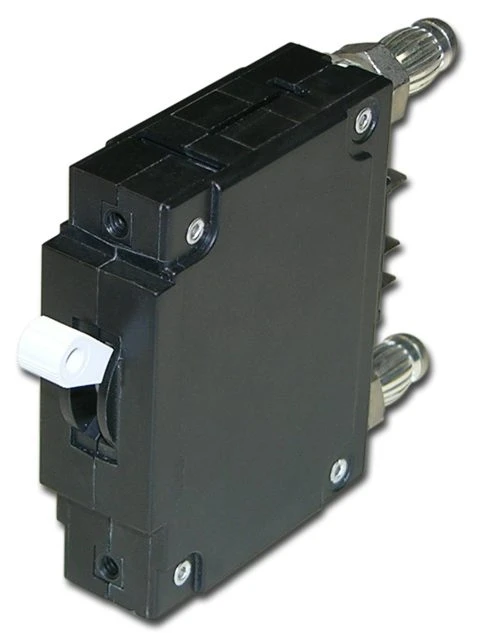
Ignition protection testing for products used in marine environments.
The standard describes basic methods for testing ignition protection of electrical products installed on boats in spaces containing gasoline engines and fuel tanks. UL notes that the procedure itself does not determine whether a product is acceptable for marine service; this is determined by the requirements of the applicable product standard.
The standard excludes explosion-proof and intrinsically safe equipment covered by U.S. Coast Guard requirements, hydrogen–air mixtures, ignition from external sources (static electricity, lightning), high-voltage electrostatic equipment, and degradation of external wiring and installation connections.
The designation “Ignition Protected” or “UL 1500 Marine-Ignition Protected” in a circuit breaker datasheet means that the product, while operating in a propane–air mixture containing 4.25–5.25% propane by volume at rated voltage and load, does not ignite that mixture.
The standard provides three ways to meet the requirement: the enclosure contains the flame after ignition of the mixture inside the product (Sections 9 and 10), spark energy is too low to ignite the mixture (Section 11), or the ignition source is hermetically isolated from the surroundings (Section 12).
The designation demonstrates compliance with 33 CFR 183.410 and ABYC E-11 for engine and fuel-tank spaces on gasoline-powered boats. It does not demonstrate explosion-proof construction to Ex/ATEX requirements or suitability for hazardous industrial areas.
Section 9 describes the internal gas/air mixture ignition test: a propane–air mixture is supplied to the explosion chamber at approximately 0.03 m³ (1 cubic foot) per minute, maintaining a propane concentration of 4.25–5.25% by volume (the approximate lower and upper explosive limits of propane are 2.2% and 9.5%, respectively).
The mixture in the test product is ignited by a spark plug supplied from a high-voltage source, and a pressure indicator confirms that an explosion occurred; a test in which ignition does not occur is repeated. A total of 50 tests are performed: 25 with the concentration varied in small increments over the 4.25–5.25% range and 25 at the concentration that produced the highest explosion pressure.
For products with accessories affecting the flame path, an additional 10 tests are performed under load and 10 without load (3 s), as well as 10 locked-rotor tests (10 s). Section 10 covers ignition caused by temperatures above 150 °C: the component is brought to its maximum temperature at 120% of rated voltage and the condition is maintained for at least 5 minutes in a 4.25–5.25% mixture.
Section 11 describes the electrical-energy test: a circuit containing a potential spark source is connected to the test apparatus, the device is supplied at 120% of rated voltage, and the apparatus contacts are opened and closed 60 times per minute, at least 50 times, with at least 25 tests performed at a propane concentration of 5.25 ±0.25%; apparatus performance is verified using a 24 V, 3 A resistive circuit with 10 µH inductance.
Section 12 describes hermetic isolation of the ignition source: an enclosure without openings, or with threaded joints of at least three full threads, or joints that are welded, soldered, brazed or glass-sealed (O-rings and feedthrough seals are not permitted). Tightness is verified by conditioning for 24 h at 0 °C and immersion to a depth of 0.3 m in 40 °C water for 1 h without release of bubbles.
Section 13 addresses impact sparks from moving parts - the test is performed 50 times in an explosion chamber at 1.5 times the maximum speed. A compliant product is marked “Ignition Protected” (Section 14); ABYC also recognizes the markings “SAE J1171 MARINE” and “ISO 8846 MARINE”.
Check whether the datasheet states the marking and reference standard (UL 1500, SAE J1171 or ISO 8846) and whether it applies to the complete circuit breaker in the specified enclosure version; for Ex applications, require an ATEX/IECEx certificate because ignition protection to UL 1500 does not replace explosion-proof construction.