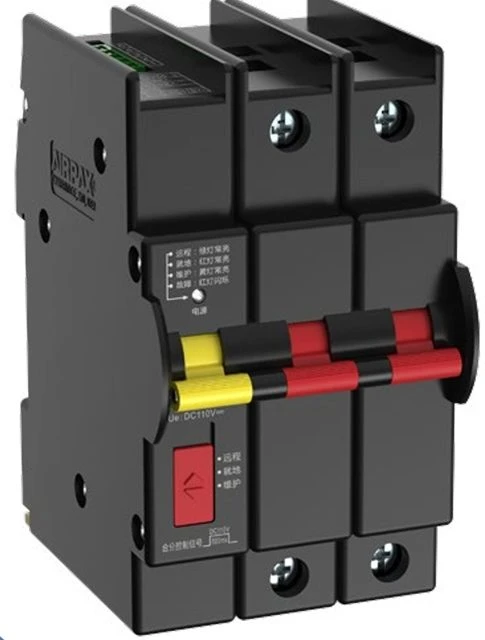
Airpax ICLR with the ROCB module can switch, disconnect and reset protection on command from an interlocking or onboard computer-without travelling to the cabinet. For a wayside cabinet, tunnel installation or unattended facility, this is the difference between clearing a trip in seconds and dispatching a service team. Remote operation does not compromise protection quality: the motor module only moves the handle, while the current path and tripping mechanism remain the same as in an ICL breaker without the module. Protection remains hydraulic-magnetic, so its characteristic does not change with ambient temperature-in an unheated cabinet there is no need to oversize rated current to avoid nuisance tripping. Feedback is also provided: the device reports contact position to a controller input, so the dispatcher knows whether the circuit has been switched off manually or the protection has tripped.
The device mounts on 35 mm DIN rail; the ROCB (Remote Operated Circuit Breaker) module occupies a housing the same width as one breaker pole. One-, two- and three-pole versions are available, rated up to 63 A at 80 V DC, 110 V DC, 240 V AC and 415 V AC, with a rated interrupting capacity of 10,000 A at 80 and 110 V DC.
ON and OFF commands use separate control inputs, terminals R3 and R4, and are given as a 110 V DC rectangular pulse lasting 350–650 ms. With two separate pulse inputs, an open control conductor leaves the device in its existing position. The datasheet mentions interference immunity of the control signal but does not specify standards or test levels for this feature. Consumption is 0.25 A for one second during switching, corresponding to 25 W, and below 30 mA at rest. A 110 V DC cabinet power supply should therefore be sized for the number of modules switched simultaneously; standby current is negligible.
Terminal R5 reports contact position-0 when ON, 1 when OFF-at up to 30 mA, suitable directly for a binary input of a controller or onboard TCMS (Train Control and Management System). The datasheet also lists state retention after power loss, automatic return, emergency operation and three modes: remote, local and service; their behaviour is not described in the datasheet and should be confirmed with the manufacturer before control logic is designed.
Manual control has priority over remote operation: forcing the handle overrides a command from the supervisory system. Railway applications with evacuation procedures require this-the operator must be able to isolate the circuit locally regardless of what the control system is doing.
The motor module narrows the temperature range of the complete assembly. The hydraulic-magnetic breaker retains ratings and trip characteristics from −40 to +85 °C, while the ROCB datasheet specifies −20 to +60 °C for the module. In an unheated wayside cabinet, selection therefore begins with ambient temperature.
Switching endurance is 10,000 cycles at three operations per minute, with movement time below one second. These two values define the application: remote switching and shutdown of a circuit, remote reset without travelling to the cabinet, and load shedding-not cyclic load switching, for which a contactor is intended.
The datasheet declares compliance with EN 50155:2017 and IEC 60077-1:2017, vibration and shock resistance according to IEC 61373 and MIL-STD-202, and materials meeting NFPA 130 and EN 45545-2 fire and smoke requirements. Approvals include UL 1077, CSA C22.2 No. 235, TÜV according to IEC 60947-2, GB 14048.2 and CRCC. Options include one handle per breaker (ICLR) or per pole (ICLHR), versions with intermediate-position indication (ICLMR, ICLMHR), short-delay, long-delay, motor-start and instantaneous curves for DC, 50/60 Hz, 400 Hz and DC/60 Hz versions, inertial delay (letter F in the code) for loads with high inrush current, test button, auxiliary and alarm contacts, and vented or sealed construction. Quick-connect terminals are selected for the Tyco 110 series.
Main features: