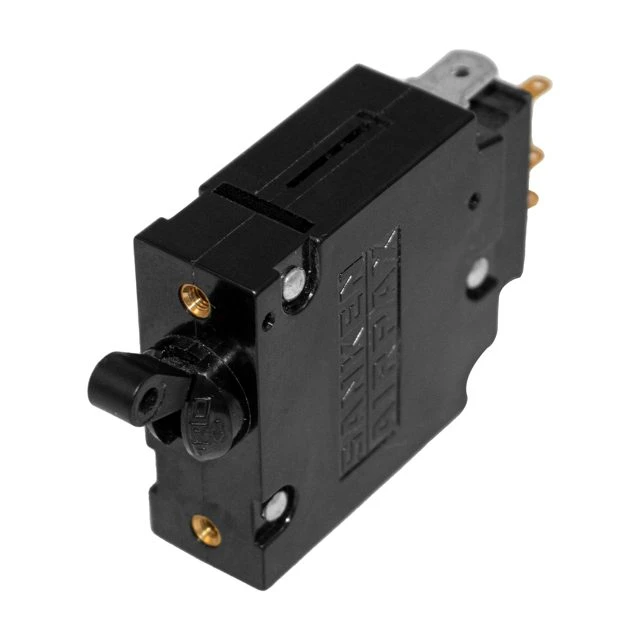
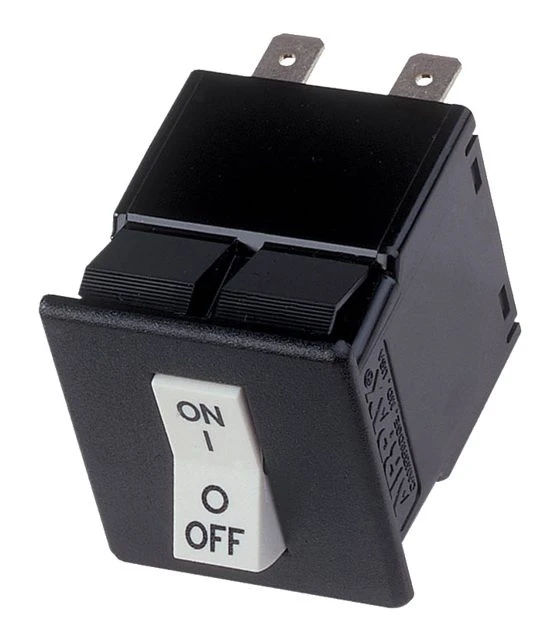
Circuit-breakers for equipment (CBE) - up to 440 V AC / 250 V DC, 125 A; German edition DIN VDE 0642.
The standard applies to mechanical switching devices designed as circuit-breakers for equipment (CBE, German: Geräteschutzschalter) for household and similar applications. CBEs protect circuits inside equipment, including components such as motors and transformers.
The scope covers CBEs with rated voltages up to 440 V AC or 250 V DC, rated currents up to 125 A and short-circuit capacities of 6–3000 A, and includes guidance on coordination with short-circuit protective devices. The standard states that CBEs are not suitable for protecting building-installation conductors against overcurrent.
A reference to “VDE 0642” in a data sheet means the manufacturer relates the circuit-breaker design or testing to the German edition of IEC 60934 (circuit-breakers for equipment); the VDE number itself is not a certification mark. Compliance with IEC/EN 60934 is confirmed only by a certificate issued by a body (e.g. VDE, TÜV, UL) that cites the standard.
The standard classifies the product as equipment protection and distinguishes it from circuit-breakers for household installations according to IEC 60898 and industrial circuit-breakers according to IEC 60947-2.
The VDE classification (VDE 0642) is assigned by DKE to German editions of DIN EN electrotechnical standards; the VDE number identifies the same document as DIN EN IEC 60934. Type testing of a CBE according to this standard is performed by the manufacturer's laboratory or an independent body; the result is a test report and, in certification schemes (VDE, TÜV), additionally a certificate and production surveillance.
The data sheet should state whether it refers to a certificate or merely to a manufacturer's declaration that the product was “designed according to” the standard.
Testing to IEC 60934 confirms the breaking capacity and switching endurance of a circuit-breaker protecting circuits inside equipment (power supply, panel, cabinet) - an important parameter when protecting onboard loads in applications where IEC 60947-2 or IEC 60898 is not required.