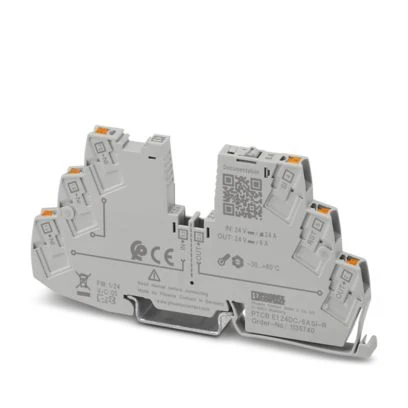
PTCB E1 electronic circuit breakers protect a single 24 V DC load circuit against overload and short circuit. The family contains 16 items: fixed-current versions rated 1, 2, 3, 4, 6 and 8 A and adjustable versions covering 1…3 A, 1…4 A and 1…8 A in 1 A steps. Mounting width is 6.2 mm, efficiency exceeds 99%, voltage drop ranges from 0.1 V at 6 A to 0.2 V at 8 A, protection is IP20 and operating temperature is −30 °C…60 °C. Total module input current is 24 A. The tripping characteristic is matched to the voltage behaviour of switched-mode power supplies, so the power source does not need to be oversized merely to obtain the current required to trip the protective device.
Variants differ in signalling: S-status output, SI-inverted-logic status output, NO-potential-free contact, R-reset input. The reset input permits remote re-energization and allows the device to be located outside the driver’s working area while retaining operation from the control desk. Integrated status signalling reports a trip without separate input modules, which is valuable in unattended wayside cabinets and interlockings.
Datasheets list EN 61373 for resistance to mechanical shock and rolling-stock vibration and EN 45545-2 for fire protection in rail vehicles-unlike the multi-channel CBM, where both standards appear only in the catalogue table, here they are stated directly in the item document. Datasheets also list EN 50178 for electronic equipment in high-power installations, EN 61000-6-2 and EN 61000-6-3 for electromagnetic compatibility, and environmental tests EN 60068-2-6 (sinusoidal vibration), EN 60068-2-27 (shock), EN 60068-2-30 (cyclic damp heat) and EN 60068-2-78 (steady-state damp heat). The Phoenix Contact railway catalogue table additionally marks EN 50121-3-2 for all 16 items, with a note about immunity to 1 kV burst pulses; the datasheet specifies that the signal-line connection was tested to EN 61000-4-4 at 1 kV and that additional protective measures may be required. The devices carry UL/C-UL Listed UL 508, UL Recognized UL 2367, ANSI/UL 121201 Class I Division 2 Groups A–D T4 and DNV GL approvals.