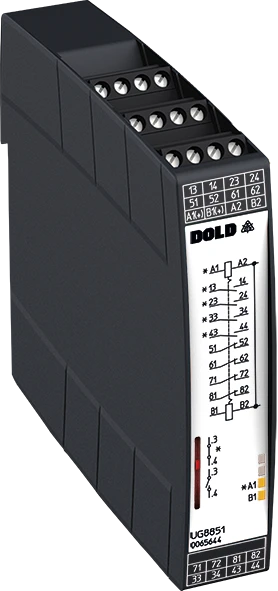
The latching relay changes the contact state with a short voltage pulse on the set input and returns with a pulse on the reset input; it draws no energy to hold the ON state, and on loss of supply it stays in its last position. DOLD presents this as energy saving and lower heat dissipation in the cabinet, and as the conversion of pulse control into a continuous function. Both inputs accept pulses or continuous voltage; when both coils are energised, the contacts keep the state of the first energised coil.
The contacts are forcibly guided according to IEC 61810-3, so the relay state can be monitored by the opposite contact. A lever on the front allows manual operation and indicates the contact position, and a sealable transparent cover protects the settings against manipulation. Pluggable, coded terminal blocks allow the device to be exchanged without disconnecting wires. One version covers a wide range of AC and DC control voltages.
For railways we propose it for circuits that must remember their state after a loss of battery or mains voltage: interlocks, fault memories, operating mode selection in the equipment cabinet and in trackside cabinets. The datasheet gives a classification of vibration and shock resistance to EN 50155 / EN 61373.
Parameters (UG 8851.19PS, from the datasheet):