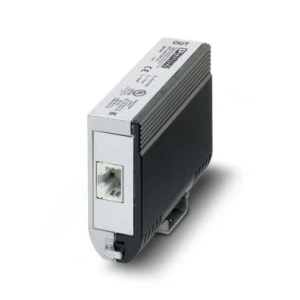
Data transmission networks and antenna lines are particularly exposed to surges because they run between facilities distributed over a large area, often in exposed locations. The consequence of damage is not only the cost of replacing equipment-a lost link also means loss of diagnostic data and surveillance video, and therefore loss of control over the facility. DT-LAN-CAT.6+ is intended for protecting copper Ethernet lines: it is a Class EA device corresponding to CAT6A, suitable for Gigabit Ethernet with throughput up to 10 Gb/s, as well as legacy Token Ring, FDDI, CDDI, ISDN and DS1 technologies. It supports power over twisted pair in the PoE++ standard, also known as 4PPoE, in Mode A and Mode B, allowing cameras and access points powered directly from the transmission cable to be protected. It is designed as an inline RJ45 plug with a separate grounding conductor and a grounding foot for an NS 35 DIN rail, so it requires no modification of existing sockets.
The PP-RJ-SCC-F patch panel combines line distribution and protection: it has RJ45 sockets routed to Push-in DIN-rail terminal blocks, supports CAT5e at 10, 100 and 1000 Mbit/s, and is mounted on a DIN-rail adapter with IP20 protection. It includes a shield connection with mechanical strain relief and shield-current monitoring, making it possible to detect incorrect grounding before it causes transmission interference.
Coaxial signal interfaces, especially antenna lines in radio systems, are protected by the CN-LAMBDA/4-2.25-BB adapter. It uses quarter-wave Lambda technology, which diverts surge energy without introducing attenuation in the useful frequency band. It is designed as an N-connector female-to-female coupler, enabling installation in an existing line without modifying the cabling.
Datasheet parameters