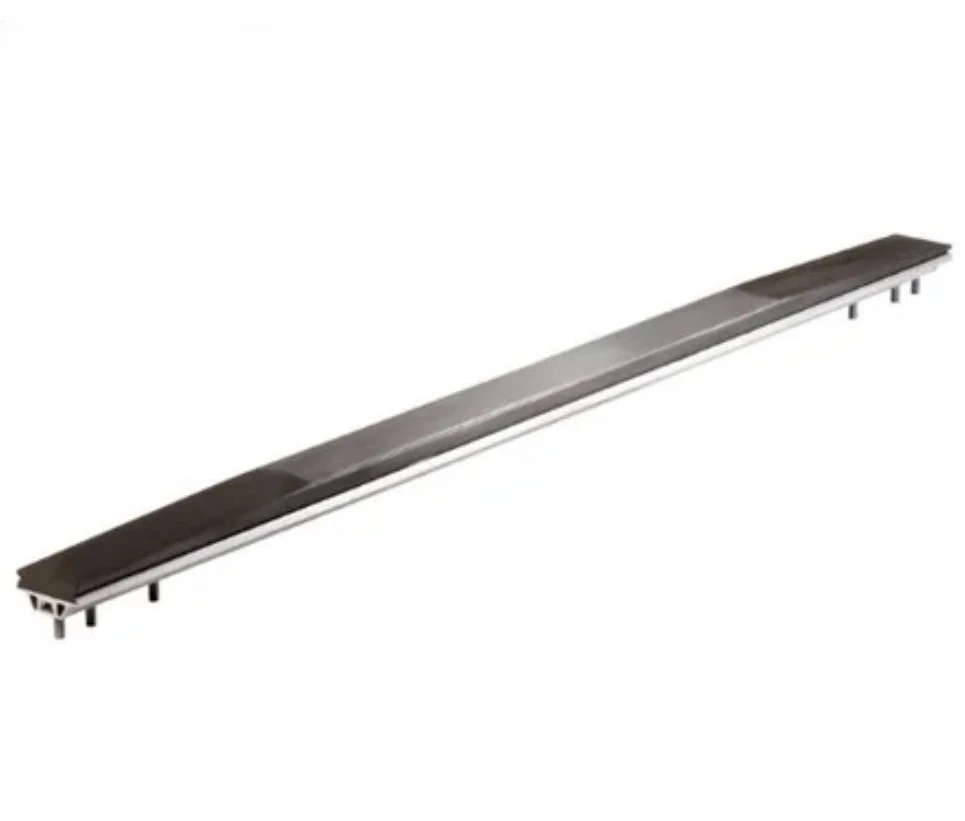
Extruded carbon contact strips for pantographs operating on AC and DC overhead lines reduce contact-wire wear compared with metal strips and provide spark-free current collection. The strip consists of a carbon profile mounted on a carrier made of aluminium, galvanized steel or copper; the carrier conducts current and stiffens the profile against bending.
The material grade is selected according to the network and current. For 15 kV and 25 kV AC networks, Mersen uses pure graphite; for 3 kV, 1.5 kV and 750 V DC networks and lines in poorer condition, metal-impregnated graphite is used. The selection criterion is the continuous linear current density j (A/mm) at the contact edge, calculated from the pantograph current, strip width and number of strips (the first of two strips carries approximately 60% of the current). Four main grades according to the guide: AR129 (pure graphite, jmax 6 A/mm, resistivity 30 µΩ·m), P5696 (22% Cu, 12 A/mm, 6.0 µΩ·m), P2805 (28% Cu, 19 A/mm, 3.5 µΩ·m), P3210 (32% Cu, 22 A/mm, 2.2 µΩ·m); indicative values at a graphite/carrier interface temperature of 160 °C. Copper content is limited by strip mass and the risk of overheating and burning the contact wire.
Versions: welded strips (electrolytically copper-plated profile), bonded strips (bonding certified to DIN 6701-1), Kasperowski design (copper carrier, welded and clamped profile), versions with integrated horn and versions for automatic dropping device (ADD) systems. In the ADD version, a pneumatic channel in the strip monitors its condition: after cracking or excessive wear, pressure drops and the pantograph lowers automatically before damaging the contact wire.
Strip wear depends primarily on electrical factors (collected current and regenerative-braking current), followed by mechanical factors (speed, contact force, condition and vibration of the contact wire, mixed operation with metal strips) and environmental factors. The Mersen technical guide includes the selection method, a material-grade table and a contact-strip inquiry form.
Key features: